Jumaat, 7 Mac 2014

Chapter 19- Outsourcing in the 21 century

Outsourcing projects
  • Insourcing-a common approach using the professional expertise within an organization to develop and maintain the organization's information technology systems.
  • Outsourcing- an arrangement by which one organization provides a service or services for another organization that chooses not to perform them in-house.s.
  • Onshore outsourcing-engaging another company within the same country for the service.
  • Nearshore outsourcing-contracting outsourcing arrangement with a company in nearby country.
  • Offshore outsourcing-using organizations from developing countries to writes code and develop systems.
 Factors driving outsourcing growth:-Core competencies, financial saving, rapid growth, the internet.

Outsourcing benefits
  1. Increased quality and effiency
  2. Reduced operating expenses
  3. Outsourcing non-core processes
  4. Increased flexibility
Outsourcing challenges
  1. Competitive edge
  2. Confidentiality
  3. Scope definition
  4. Contract length-difficulties in getting out of the contract and problems in foreseeing future needs.

chapter 15- creating collaborative partnership

Organizations create and use teams, partnerships and alliances to:
  1. -Undertake new initiatives
  2. -Address both minor and major problems
  3. -Capitalize on significant opportunities

  • Organizations create teams, partnerships and alliances both internally with employees and externally with other organizations.
  • Collaboration system-supports the work of teams by facilitating the sharing and flow of information.

Teams, partnerships and alliances
  • Organizations form alliances and partnerships with other organizations based on their core competency.
  • Core competency- an organization's key strength, a business function that it does better than any of its competitors
  • Core competency strategy-organization chooses to focus specifically on its core competency and forms partnerships with other organizations to handle non strategic business processes.
  • Information technology can make a business partnership easier to establish and manage
- Information partnership-occurs when two or more organizations cooperate by integrating their IT systems, thereby providing customers with the best of what each can offer.
  • The internet has dramatically increased the ease and availability for IT-enabled organizational alliances and partnerships.


2 categories of collaboration
  1. Unstructured collaboration (information collaboration)- includes document exchange, shared whiteboard, discussion forums and e-mail.
  2. Structured collaboration (process collaboration)- involves shared participation in business processes such as workflow in which knowledge is hardcoded as rules.

Collaboration systems include:
-knowledge management systems
-content management systems
-workflow management system
-groupware systems

Knowledge Management Systems
  • Knowledge management (KM)- involves capturing, classifying, evaluating, retrieving,and sharing information assets in a way that provides context for effective decisions and actions.
  • Knowledge management system-support the capturing and use of an organization's ''know-how''

Explicit nd Tacit knowledge
  • Intellectual and knowledge-based assets fall into two categories
  1. Explicit knowledge- consists of anything that can be documented, archieved and codified often with the help of IT.
  2. Tacit knowledge-knowledge contained in people's heads.
  • The following are two best practices for transferring or recreating tacit knowledge
-shadowing-less experienced staff observe more experienced staff to learn how their more experienced staff to learn how their more experienced counterparts approach their work.
-Joint poblem solving- a novice and expert work together on a project.


KM Technologies systems included:
-Knowledge repositories, expertise tools, E-learning applicants, discussion and chat technologies.

KM and social networking
Finding out how information flows through an organization
  • Social networking analysis (SNA)-  a process of mapping a group's contacts to identify who knows whom and who works with whom
  • SNA provides a clear picture of how employees and division work together and can help identify key experts.

Content Management system (CMS)- provides tools to manage the creation, storage,editing and publication of information in a collaborative envitonment.
CMS marketplace includes:
-Document management system (DMS)
-Digital asset management system (DAM)
-Web content management system (WCM)

Working Wikis
  • Wikis-web-based tools that make it easy for users to add , remove, and change online content.
  • Business wikis- collaborative web pages that allow users to edit documents. share ideas, or monitor the status of a project.

Workflow management systems
  • Workflow-defines all the steps or business rules, from begining to end, required for a business process
  • Workflow management system-facilitates the automation and management of business process and controls the movement of work through the business process.
  • Messaging-based workflow system-sends work assignments through an e-mail system.
  • Database-baesed workflow system-stores documents in a central location and automatically asks the team members to acess the document when it is their turn to edit the document.

Groups systems
  • Groupware-software that supports team interaction and dynamics including calendaring, scheduling and videoconferencing.
  • Videoconference-a set of interactive telecommunication technologies that allow two or more locations to interact via two-way video and audio transmissions simultaneously.
  •  Web conferencing-blends audio, video, and document sharing technologies to create virtual meeting rooms where people ''gather'' at a password-protected web site.
  • Instant messaging- type of communications services that enables someone to create a kind of private chat room with another individual to communicate in real-time over the internet.


Jumaat, 21 Februari 2014

chapter 14 ; E-business

E-business
The internet is a powerful channel that presents new opportunities for an organization to:
- Touch customer, enrich products and services with information, reduce cost

E-commerce - the buying and selling of goods and services over the internet.
E-business - the conducting of business on the internet including not only buying and selling but also serving customers and collaborating with business partners.


E-business models-approach to conducting electronic business on the internet.


http://www.vancechan.com/images/e-commerce_models.gif


https://blogger.googleusercontent.com/img/b/R29vZ2xl/AVvXsEhTuc5K990R-D_lcrAscEDdOC8o0zLaQngCx-uxhwVOjl7RIlQ6qRuqzcuamByiviOzXBm0eGAU7MXC5FCcI4dnUON5z0E6k4-hpLwkSvwfzYCzgJ_mLAdsOFUcvb6ZSb1MY8UQTZpmEhk/s1600/ebusiness+model.png
Business- to- business (B2B)
Electronic marketplace- interactive business communities providing a central market where multiple buyers and sellers can engage in e-business activities.

Business-to- consumer (B2C)
E-shop- a version of a retail store where can shop at any hour of the day without leaving their home or office.

E-mall - consists of a number of e-shop, it serves as a gateway through which a visitor can acess other e-shops.

Business types
-Brick -and- motar business
-Pure-play business
-Click- and -motar business

Consumer-to- Business (C2B)
The demand for C2B e-business will increase over the next few years due to customer's desire for greater convenience and lower prices.E.g- Priceline.com.


Consumer-to consumer (C2C)
Online auctions

Electronic auction (e-auction)- sellers and buyers solicit consecutive bids from each other and prices are determined dynamically.

Forward auction- sellers use as a selling channel to many buyers and the highest bids wins.
  
 Reserve auction-buyers use to purchase products or service, selecting the seller with the lowest bid.


C2C communities:

Communities of interest- people interact with each other on specific topics such as golfing.
Communities of relations- people come together to share certains life experiences such as cancer patients.
Communities of fantasy- people participate in imaginary environments such as playing one-on one with Michael Jordan.


E-business benefits
-highly accesible, decreased cost, increased customers loyalty.

E-business challenges
-protecting consumers, increasing liability, providing security.


There are numerous advantages and limitations in e-business revenues models
-license fee, advertising fees,transaction fees.

Web Mashups- a web sites or application that uses content from more than one resource to create a completely new service
- Application programming interface (API) -  a set of routines, protocols, and tools for building software applications.
- Mashups editor - WSYIWYGs ( What You See Is What You Get) for mashups.

chapter 12 : Integrating the organization from end to end - Enterprise Resource Planning

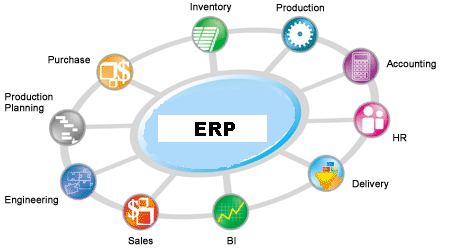
At the heart of all ERP systems is a database, when a user enters or updates information in one module, it is immediately and automatically updated throughout the entire system.


 http://www.dataccount.com/wp-content/uploads/2013/01/erp_modules.gif


Integrating SCM, CRM, AND ERP
  • SCM, CRM and ERP are the backbone of e-business
  • Integrating of these application is the key to sucess for many companies
  • Integration allows the unclocking of information to make it available to any user, anywhere, anytime. 

 The evoulution of ERP

1990-ERP
-order entry,distribution, accounting, materials planning.

2000-Extended ERP
-scheduling, forecasting, capacity planning, logistics.

Present -ERP II
-project management, portal capability,human resource management.


                                                Integrating SCM, CRM and ERP


http://files.iipm1113.webnode.com/200000041-c96e4ca696/17_Integrated_SCM_CRM_and_ERP.JPG


Integration tools

Many companies purchase modules from and ERP vendor, an SCM vendor and CRM vendor and must integrate the different modules together.

-middle - several different types of software which sit in the middle of and provide connectivity between two or more software applications.

-Enterprise application integration (EAI) middleware - packages together commonly used functionality which reduced the time necessary to develop solutions that integrate applications from multiple vendors.


ERP systems must integrate various organization processand be:

-flexible, modular and open, comprehensive and beyond the company.


chapter 11 : Buildinga a customers - centric organization-customer relationship management.

CRM enables an organization to:
-provide better customer service.
-make call centers more efficient.
-cross sell products more effectively.
-increase customer revenues.


Organizations can find theirs most valuable customers through ''RFM'' - Recency, Frequency, and Monetory value.
-How recently a customer purchased items.
-How frequently a customer purchased items.
-How much a customer spends on each purchase.


The evolution of CRM
  • CRM reporting technology - help organizations identify their customers across other applications.
  • CRM- help organization segment their customers into categories such as best and worst customers.
  • CRM predicting technologies- help organizations make predictions regarding customer behavior such as which customers are at risk of leaving.
 Using Analytical CRM to enchance decisions
  • operational CRM-support traditional transactional processing for day to day front office operations or systems that deal directly with customers.
  • analytical CRM - supports back office operation and strategic analysis and includes all systems that do not deal directly with the customers. 
 CRM success factors
  1. Clearly communicate the CRM strategy
  2. Define information needs and flows
  3. Build an integrated view of the customer
  4. Implement in iterations

Chapter 10 ; Extending the organization- Supply Chain Management

The Supply chain has three main links:
  1. Material flow from the suppliers and their ''upstream '' suppliers at all levels.
  2. Transformation of materials into semifinished and finished products through the organization's own production process.
  3. Distribution of products to customers and their '' downstream'' customers at all levels.

Information Technology's Role in the supply chain.
Planning and control supply chain integration
-example: supply chain planning, collaborative product development.

Information Integration
-example: Inventory visibility, performance metrics

Business process integration
-example: Commerce web sites.


Factor driving SCM

visibility
  • Supply chain visibiliy-the ability to view all areas up and down the supply chain.
  • Bullwhip effect-occurs when distorted product demand information passes from one entity to the next throughout the supply chain.
Consumer behavior
  • Companies can respond faster and more effectively to consumer demands through supply chain enchances.
  • Demand planning software-generates demand forecasts using statistical tools and forecasting techniques.
competition
  • supply chain planning (SCP)- uses advanced mathematical algorithms to improve the flow and effiency of the supply chain.
  • supply chain execution (SCE) software-automates the different steps and stages  of the supply chain.
speed
 factor fostering speed
  •  Information is crucial to manager's abilities to reduce inventory and human resources requirements to a competitive level.
  • Information flows are essential to strategic planning for and development of resources.
 Supply Chain Management Sucess Factors:
  1. Make the sale to suppliers.
  2. Wean employees off traditional business practices.
  3. Ensures the SCM system supports the organizational goals.
  4. Deploy in icremental phases and measures and communicate success.
  5. Be future oriented.
 SCM success stories
  • DSSs allow managers to examine performance and relationships over the supply chain and among:
  • suppliers, manufactures, distributors, other factors that optimize supply chain performance.

Sabtu, 8 Februari 2014

chapter 9 : Streaming Business Operation

Decision Making
Reasons for the growth of decision -making information systems.
  • People must make decisions quickly.
  • People need to analyze large amounts of information.
  • People must protect the corporate asset of organizational information.
  • -model-a simplified representation or abstraction of reality.

Transaction processing systems-the basic business system that serves the operational level in an organization.

  1. Online transaction processing (OLTP)-the capturing of transaction and event information using technology to (1) process the information according to defined business rules, (2) store the information, (3) update existing information to reflect the new information.
  2. Online analytical processing (OLAP)- the manipulation of information to create business intelligence in support of strategic decision making.
  3. Desicion support system (DSS)-models information to support managers and business professionals during the decision -making process.

Three quantitative models used by DSSs include:
  1. Sensitivity analysis-the study of the impact that changes in one parts of the model have on other parts of the model.
  2. What-if analysis-checks the impact of a change in an assumption on the proposed solution.
  3. Goal -seeking analysis -finds the inputs necessary to achieve a goal such as a desired level of output.
Executive Information Systems (EIS)-a specialized DSS that supports senior level executives within the organization.
  • Consolidation-involves the aggregation of information and features simple rolls-ups to complex groupings of interrelated information.
  • Drill-down-enables users to get details, and details of details, of information.
  • Slice-and-dice-looks at information from different perspectives.
  • -Digital dashboard-integrates information from multiple components and presents it in an unified display.
  • -Intelligent system-various commercial applications of artificial intelligence.
  • -Artificial intelligence-simulates human intelligence such as the ability to reason and learn.
4 most common categories:
  1. Expert system-computerized advisory program that imitate the reasoning processes of experts in solving difficult problems.
  2. Neutral network-atempts to emulate the way the human brain works.
  3. Genetic algorithm- an artifical intelligent system that mimics the evolutionary, survival-of-the-fittest process to generate increasingly better solutions to a problem.
  4. Intelligent agent-special-purposed knowledge-based information system that accomplishes specific tasks on behalf of its users.
  5.  
Common data mining analysis capabilities-cluster analysis,association detection, statistical analysis.
  • CLUSTER ANALYSIS-a technique used to divide an information set into mutually exclusive groups such that the members of each group are as close together as possible to one another and the different groups are as far apart as possible.
  • ASSOCIATION DETECTION-reveals the degree to which variables are related and the nature and frequency of these relationships in the information.
  • -Market basket analysis-analyzes such as items as web sites and checkout scanner information to detect customers'buying behavior and predict future behavior by identifying affinities among customers choices of products and services.
  • STATISTICAL ANALYSIS-performs such functions as information correlations,   distributions, caculations, and variance analysis.
  • - forescast-predictions made on the basis of time-series information.
  • -time-series information-time-stamped information collected at a particular frequency.

chapter 8 :Accessing Organizational Information-Data Warehouse

  • Data warehouse- a logical collection of information-gathered from many different operational databases-that supports business analysis activities and decision-making tasks.
  • The primary purpose of a data warehouse is to aggregate information throughout an organization into a single repository for decision-making purpose.

 Data Warehouse Fundamental.
  •  Extraction, transformation, and loading (ETL)- a process that extracts information from internal and external databases, transforms the information using a common set of enterprise definitions, and loads the information into a data warehouse.
  • Data mart-contains a subsets of data warehouse information.

                                     Data Warehouse Model


https://blogger.googleusercontent.com/img/b/R29vZ2xl/AVvXsEgTleW5oiAGoAi_iMABrT_M1IlhTqj7qkQ48Kfyf0pyBiqSPMHGd9gLF39F1joiu87udB817VMi66K5ziFNbz6LN3CaRghDL1xLDaZ5yU5WoMhU-KNST2CAjXzdI7hig2_nw0ESJMXzKkOi/s1600/15_Data_Warehouse_Model.png


Multidimensional Analysis and Data Mining
  • Databases contain information in a series of two-dimensional tables.
  • In a data warehouse and data mart, information is multidimensional, it contains layers of columns and rows. -dimension-a  particular attribute of information.
  • Cube- common term for the reprensentation of multidimensional information.
  • Data mining- the process of analyzing data to extract information not offered by the raw data alone.
  • Data mining tool-uses a variety of techniques to find patterns and relationship in large volumes of information and infers rules that predict future behavior and guide decision making.
  • -Information cleansing or scrubbing- a process that weeds out and fixes or discards inconsistent, incorrect or incomplete information.
  • -Business intelligence-information that people use to support their descision-making effort.This principle enablers-technology, people, culture.


Jumaat, 31 Januari 2014

chapter 7: Storing Organizational Information-Databases

  • Database- maintains information about various types of object, event , inventory, people and place.
  • Hierarchical database model-information is organized into a tree-like  structure in such a way that it cannot have too many relationships.
  • Network database model-a flexible way of representing objects and their relationships.
  • Relational database model-stores information in the form of logically related two-dimensional tables.
  • Entity- a person, place, thing or event about which information is stored.
  • Attributes- characteristics or properties of an entity class.
  • Primary key- a field that uniquely identifies a given entity in a table.
  • Foreign key- a primary key of one table that appears an attribute in another table and acts to provide a logical relationship among two tables. 

  • Relational database advantages:-
           -Increased flexibility
           -Increased scalability and performance
           -Reduced information redundancy.
          -Increased information integrity.
          -Increased information security.


  1. Increased flexibility-handle changes quickly and easily, provide users with the different views, have only one view, have mutiple logical views.
  •  A database must scale to meet increased demand, while maintaining acceptable performance levels.
          -Scalability-refers to how well a system can adapt to increased demands.
          -Performance-measures how quickly a system performs a certain process.

     2 .  Reduced information redundancy
  • Redundancy-the duplication of information or storing the same information in multiple place. 
    3.  Increased information integrity:-       
          -Information integrity-measures the quality of information.
          -Integrity constraint-rules that help ensure the quality of information.

     4.  Increased information security
         - information is an organization asset and must be protected.


  • Database features:-
  1. password-provides authentication of the user.
  2. access level-determines who has access to the different types of information.
  3. access control -determines types of user access.


  • Database management systems-software through which users and application programs interact with a database.
  • Data-driven web sites-an interactive web site kept constantly updated and relevant to the needs of its customers through the use of database.

  • advantages:
  1. Development
  2. Content management 
  3. Future expandability
  4. More efficient
  • Integrating Information among Multiple Database.
  1. Forward integration-takes information entered into a given system and sends it automatically to all downstream system process.
  2. Backward integration-takes information entered into a given system and sends it automatically to all upstream systems and process.
  3. without integration, an organization will spend considerable time entering the same info in multiple system.

Jumaat, 17 Januari 2014

Chapter 6 -Valuing Organizational Information.


Organizational Information


  • Employees must be able to obtain and analyze the many different levels, formats, and granularities of organization of organization informational to make decisions.
  • Sucessfully collecting, compiling, sorting. and analyzing information can provide tremendous insight into how an organization is performing.

  • Levels, formats, and granularities of organizational information.


https://blogger.googleusercontent.com/img/b/R29vZ2xl/AVvXsEhNIQPm_KytCcsDDO10mqu_67Y-kNel8iHpkqcjKwaEkIxMl0x29Q9GdIcyZioxXt4li4K0sika4EMMTxoC1BpgVjLaL4D1r_HgQNaQeepskHgzy_0TXLHcElaAV9E_UbFNQD0dTxrGRII/s640/Picture2.jpg


  • The value of transactional and analytical information.


https://blogger.googleusercontent.com/img/b/R29vZ2xl/AVvXsEhrQ0d-loBjzLN7H-CWoGCzJ7v8eMTIcWqMSbtqKlEwgMrs9dCgKlsNdqHecCTGVOps4hjc-Ax2gPtFIByQiehdQEkOSmqc412FWcarpuA9plWoq7azEc8zcgB0fSkmmoOlDQOGIUKEt1g/s1600/transactional+vs+analytical.png


  • The value of timely information
  1. Real-time-information-immediate, up-to- date information.
  2. Real -time system-provides real-time information in response to query requests.


  • The value of quality information
  1. Business desicions are only as good as the quality of the information used to make the decisions.
  2. Characteristics of high-quality information:-                                                                                                                                                                          -accuracy, completeness,consistency,uniqueness,timeless.


  • The 4 primary sources of low quality information:
  1. Online customers intentionally enter inaccurate information to protect their privacy.
  2. Information from different systems have different entry standards and formats.
  3. Call center operators enter abbreviated or errorenous information by accident or to save time.
  4. Third party and external information contains inconsistencies, inaccuracies and errors.


  • Potential business effects resulting from low quality information:-
         -Inability to accurately track customers.
         -Difficulty identifying valuable customers.
         -Marketing to nonexistent customers.
  • High qualiy information can significantly improve the chances of making a good decision.
  • Good decisions can directly impact an organization's bottom line.


Sabtu, 11 Januari 2014

Chapter 5-Organization Structure that support strategic initiatives

Recent IT-related strategic position:
  • Chief Information Officer (CIO)
  • Chief Technology Officer (CTO)-responsible for ensuring the throughout speed, accuracy, availability and reliability.
  • Chief Security Officer (CSO)-responsible for ensuring the security of IT systems.
  • Chief Privacy Officer (CPO)-responsible for ensuring the ethical and legal use of information.
  • Chief Knowledge Office (CKO)-responsible for collecting, maintaining and distributing the organization's knowledge.
 
CIO-oversees all uses of IT and ensures the strategic alignment of IT with business goals and objectives.
Function:
  • Manager- ensuring the delivery of all IT projects, on time and within budget.
  • Leader-ensuring the strategic vision of IT is in line with the strategic vision of the organization.
  • Communication-building and maintaining strong executive relationship.
 
Ethics-the principles and standards that guide our behavior toward other people.
  • Privacy-the right to be left alone when you want to be, to have control over your own personal possessions and not to be observed without your consent.
  • Issues affected by technology advances:
  • Intellectual property-intangible creative work that is embodied in the physical form.
  • Copyright-The legal protection afforded an expression of an idea such as song, video games and others.
  • Pirate software-The unauthorized use, duplication, distribution, sale of copy righted software.
  • Fair use doctrine-in certain situations, it is legal to use copyrighted material.
  • Counterfeith software-Software that is manufactured to look like real thing sold as such.
 
Security-organizational information is intellectual capital-it must be protected.
  • Information security-the protection of information from accidental by persons inside or outside an organization.
  • E-business automatically creates tremendous information security for organization.

Chapter 4-Measuring the Success of Strategic Initiatives

Measuring Information Technology's Success

  • Key performance indicator-measures that are tied to business drivers.
  • Performance metrics fall into the  nebulous area of business intelligence that is neither techonolgy, nor business centered, but requires input from both IT and business professionals.
Efficiency IT metic-measures the performance of the IT system itself including throughput, speed, and availability.

Effectiveness IT metric-measures the impact IT has on business processes and activities including customer satisfaction, conversion rates, and sell-through increases.


Benchmarking-Baselining Metrics
  • Benchmarks-baseline values the system seeks to attain
  • Benchmarking-a process of continuously measuring system results, comparing those results to optimal system performance, and identifying steps and procedures to improve system performance.
Efficiency IT metrics focus on technology and include:
  • Throughput, Transaction speed, System availability, web traffic.
Efficiency IT metrics
  • Throughput-the amount of information that can travel through a system at any point.
  • Transaction speed-the amount of the time a system takes to perform a transaction.
  • System availability-the number of hours a system is available for users.
  • Information accuracy-the extent to which a system generates the correct results when executing the same transaction numerous times.
  • Web traffic-includes a host of benchmarks such as the number of page views, the number of unique visitors, and the average time spent viewing a Web page.
  • Response time-the time it takes to respond to user interactions such as a mouse click.
 
Effectiveness IT metrics
  • Usability-The ease with which people perform transactions and find information. A popular usability metric on the internet is degrees of freedom, which measures the number of clicks required to find desired information.
  • Customer satisfaction-Measured by such benchmarks as sactisfaction surveys, percentage of existing customers retained and increases in revenue dollars per customers.
  • Conversion rates-the number of customers an organization ''touches'' for the firstime and persuades to purchase its products or services. This is a popular metric for evaluating the effectiveness of banner, pop-up and pop-under ads on the internet.
  • Financial-such as return on investment, cost-benefit analysis and break-even analysis.
 
The Interrelationships of Efficiency and Effectiveness IT metrics.
  • Security is an issue for any organization offering products or services over the Internet.
  • It is inefficient for organization to implement Internet security, sinces it slows down processing.
  • Security Internet connections must offer encryption and Secure Sockets Layers.
Metrics for measuring and managing strategic initiatives included:
-web site metric, supply chain management (SCM) metrics


Web Site Metrics
  • Abandoned registrations: Number of visitors who start the process of completing a registration page and then abandon the activity.
  • Abandoned shopping carts: Number of visitors who create a shopping cart and start shopping and then abandon the activity before paying for the merchandise.
  • Click-through: Count of the number of people who visit a site, click on add and are taken to the site of the adversiter.
Supply Chain Management Metric
  • Back order: An unfilled customer order. A back order is demand against an item whose current stock level is insufficient to satisfy demand.
  • Customer order promised cycle time: The anticipated or agreed upon cycle time of a purchase order. It is a gap between the purchase order creation date and the requested delivery date.
  • Customer order actual cycle time: The average time it takes to actually fill a customer's purchase order. This mesure can be viewed on an order line level.
Customer relationship management metrics-sales metric (number of new customers),services metric (customer satisfaction level),marketing metrics (customer retention rate).

BPR and ERP Metrics-the balanced scorecard enables organization to measure and manage strategic initiatives.


Jumaat, 10 Januari 2014

Past Year 2009 ( Part D)

 
PAST YEAR 2009

PART D

QUESTION 1

Identify five (5) of competitive advantages used by AirAsia.

  • Chief Information Officer (CIO)
  • Chief Technology Officer (CTO)
  • Chief Security Officer (CSO)
  • Chief Privacy Officer (CPO)
  • Chief Knowledge Officer (CKO)

QUESTION 2
Which of the Porter's generic strategies were applied by AirAsia in the case study and explain with examples.

-Cost leadership are strategies that applied by AirAsia because it requires lower cost, broad market and satisfy customer's requirement.
-AirAsia promoting their slogan ''everyone can fly'' with lower cost to fly everywhere we want.So, everyone with different level now can go travel to anywhere they want with lower price of ticket they offer.
-They focus this strategies to broad market for example AirAsia will strengthen and enhance its route network by connecting all the existing cities in the region and expanding further into Indochina, Indonesia, Southern China and India. The airline will focus on developing its hubs in Bangkok and Jakarta through its sister companies, Thai AirAsia and Indonesia AirAsia.
-Futhermore, they satisfy customer's requirement with offer that they provided. For example they give good services to customer in term of price ticket, online booking ticket, treat customer with fair and equitable. So, they satisfy what customer want and need.


QUESTION 3
Based on Porter's Five Force Model, analyze AirAsia's buyer power and supplier power.

AirAsia's buyer power- buyer power high when there many choices of whom to buy from and low when their choices are few. For example the buyer power is high when customer get many choice from other airline to travel and lower the buyer power when customer not have choice from other airline to travel.To reduce buyer power, AirAsia need do the loyalty program. For example, appreciate their regular customer by giving reasonable discount or prize holiday.

AirAsia's supplier power-high when buyers have few choices of whom to buy from and lower when their choices are many. For example AirAsia have high supplier power when they are the only airline that offer ticket at lower cost and lower supplier power when they have competition from other airline.Through market B2B marketplaces, the supplier power can be reduced. AirAsia use private exchange because they are currently the main customer of the Airbus A320. The company has placed an order of 175 units of the same plane to service its routes.