Jumaat, 21 Februari 2014

chapter 14 ; E-business

E-business
The internet is a powerful channel that presents new opportunities for an organization to:
- Touch customer, enrich products and services with information, reduce cost

E-commerce - the buying and selling of goods and services over the internet.
E-business - the conducting of business on the internet including not only buying and selling but also serving customers and collaborating with business partners.


E-business models-approach to conducting electronic business on the internet.


http://www.vancechan.com/images/e-commerce_models.gif


https://blogger.googleusercontent.com/img/b/R29vZ2xl/AVvXsEhTuc5K990R-D_lcrAscEDdOC8o0zLaQngCx-uxhwVOjl7RIlQ6qRuqzcuamByiviOzXBm0eGAU7MXC5FCcI4dnUON5z0E6k4-hpLwkSvwfzYCzgJ_mLAdsOFUcvb6ZSb1MY8UQTZpmEhk/s1600/ebusiness+model.png
Business- to- business (B2B)
Electronic marketplace- interactive business communities providing a central market where multiple buyers and sellers can engage in e-business activities.

Business-to- consumer (B2C)
E-shop- a version of a retail store where can shop at any hour of the day without leaving their home or office.

E-mall - consists of a number of e-shop, it serves as a gateway through which a visitor can acess other e-shops.

Business types
-Brick -and- motar business
-Pure-play business
-Click- and -motar business

Consumer-to- Business (C2B)
The demand for C2B e-business will increase over the next few years due to customer's desire for greater convenience and lower prices.E.g- Priceline.com.


Consumer-to consumer (C2C)
Online auctions

Electronic auction (e-auction)- sellers and buyers solicit consecutive bids from each other and prices are determined dynamically.

Forward auction- sellers use as a selling channel to many buyers and the highest bids wins.
  
 Reserve auction-buyers use to purchase products or service, selecting the seller with the lowest bid.


C2C communities:

Communities of interest- people interact with each other on specific topics such as golfing.
Communities of relations- people come together to share certains life experiences such as cancer patients.
Communities of fantasy- people participate in imaginary environments such as playing one-on one with Michael Jordan.


E-business benefits
-highly accesible, decreased cost, increased customers loyalty.

E-business challenges
-protecting consumers, increasing liability, providing security.


There are numerous advantages and limitations in e-business revenues models
-license fee, advertising fees,transaction fees.

Web Mashups- a web sites or application that uses content from more than one resource to create a completely new service
- Application programming interface (API) -  a set of routines, protocols, and tools for building software applications.
- Mashups editor - WSYIWYGs ( What You See Is What You Get) for mashups.

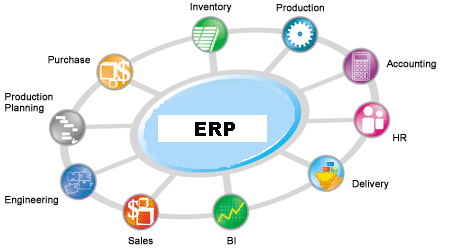
chapter 12 : Integrating the organization from end to end - Enterprise Resource Planning

At the heart of all ERP systems is a database, when a user enters or updates information in one module, it is immediately and automatically updated throughout the entire system.


 http://www.dataccount.com/wp-content/uploads/2013/01/erp_modules.gif


Integrating SCM, CRM, AND ERP
  • SCM, CRM and ERP are the backbone of e-business
  • Integrating of these application is the key to sucess for many companies
  • Integration allows the unclocking of information to make it available to any user, anywhere, anytime. 

 The evoulution of ERP

1990-ERP
-order entry,distribution, accounting, materials planning.

2000-Extended ERP
-scheduling, forecasting, capacity planning, logistics.

Present -ERP II
-project management, portal capability,human resource management.


                                                Integrating SCM, CRM and ERP


http://files.iipm1113.webnode.com/200000041-c96e4ca696/17_Integrated_SCM_CRM_and_ERP.JPG


Integration tools

Many companies purchase modules from and ERP vendor, an SCM vendor and CRM vendor and must integrate the different modules together.

-middle - several different types of software which sit in the middle of and provide connectivity between two or more software applications.

-Enterprise application integration (EAI) middleware - packages together commonly used functionality which reduced the time necessary to develop solutions that integrate applications from multiple vendors.


ERP systems must integrate various organization processand be:

-flexible, modular and open, comprehensive and beyond the company.


chapter 11 : Buildinga a customers - centric organization-customer relationship management.

CRM enables an organization to:
-provide better customer service.
-make call centers more efficient.
-cross sell products more effectively.
-increase customer revenues.


Organizations can find theirs most valuable customers through ''RFM'' - Recency, Frequency, and Monetory value.
-How recently a customer purchased items.
-How frequently a customer purchased items.
-How much a customer spends on each purchase.


The evolution of CRM
  • CRM reporting technology - help organizations identify their customers across other applications.
  • CRM- help organization segment their customers into categories such as best and worst customers.
  • CRM predicting technologies- help organizations make predictions regarding customer behavior such as which customers are at risk of leaving.
 Using Analytical CRM to enchance decisions
  • operational CRM-support traditional transactional processing for day to day front office operations or systems that deal directly with customers.
  • analytical CRM - supports back office operation and strategic analysis and includes all systems that do not deal directly with the customers. 
 CRM success factors
  1. Clearly communicate the CRM strategy
  2. Define information needs and flows
  3. Build an integrated view of the customer
  4. Implement in iterations

Chapter 10 ; Extending the organization- Supply Chain Management

The Supply chain has three main links:
  1. Material flow from the suppliers and their ''upstream '' suppliers at all levels.
  2. Transformation of materials into semifinished and finished products through the organization's own production process.
  3. Distribution of products to customers and their '' downstream'' customers at all levels.

Information Technology's Role in the supply chain.
Planning and control supply chain integration
-example: supply chain planning, collaborative product development.

Information Integration
-example: Inventory visibility, performance metrics

Business process integration
-example: Commerce web sites.


Factor driving SCM

visibility
  • Supply chain visibiliy-the ability to view all areas up and down the supply chain.
  • Bullwhip effect-occurs when distorted product demand information passes from one entity to the next throughout the supply chain.
Consumer behavior
  • Companies can respond faster and more effectively to consumer demands through supply chain enchances.
  • Demand planning software-generates demand forecasts using statistical tools and forecasting techniques.
competition
  • supply chain planning (SCP)- uses advanced mathematical algorithms to improve the flow and effiency of the supply chain.
  • supply chain execution (SCE) software-automates the different steps and stages  of the supply chain.
speed
 factor fostering speed
  •  Information is crucial to manager's abilities to reduce inventory and human resources requirements to a competitive level.
  • Information flows are essential to strategic planning for and development of resources.
 Supply Chain Management Sucess Factors:
  1. Make the sale to suppliers.
  2. Wean employees off traditional business practices.
  3. Ensures the SCM system supports the organizational goals.
  4. Deploy in icremental phases and measures and communicate success.
  5. Be future oriented.
 SCM success stories
  • DSSs allow managers to examine performance and relationships over the supply chain and among:
  • suppliers, manufactures, distributors, other factors that optimize supply chain performance.

Sabtu, 8 Februari 2014

chapter 9 : Streaming Business Operation

Decision Making
Reasons for the growth of decision -making information systems.
  • People must make decisions quickly.
  • People need to analyze large amounts of information.
  • People must protect the corporate asset of organizational information.
  • -model-a simplified representation or abstraction of reality.

Transaction processing systems-the basic business system that serves the operational level in an organization.

  1. Online transaction processing (OLTP)-the capturing of transaction and event information using technology to (1) process the information according to defined business rules, (2) store the information, (3) update existing information to reflect the new information.
  2. Online analytical processing (OLAP)- the manipulation of information to create business intelligence in support of strategic decision making.
  3. Desicion support system (DSS)-models information to support managers and business professionals during the decision -making process.

Three quantitative models used by DSSs include:
  1. Sensitivity analysis-the study of the impact that changes in one parts of the model have on other parts of the model.
  2. What-if analysis-checks the impact of a change in an assumption on the proposed solution.
  3. Goal -seeking analysis -finds the inputs necessary to achieve a goal such as a desired level of output.
Executive Information Systems (EIS)-a specialized DSS that supports senior level executives within the organization.
  • Consolidation-involves the aggregation of information and features simple rolls-ups to complex groupings of interrelated information.
  • Drill-down-enables users to get details, and details of details, of information.
  • Slice-and-dice-looks at information from different perspectives.
  • -Digital dashboard-integrates information from multiple components and presents it in an unified display.
  • -Intelligent system-various commercial applications of artificial intelligence.
  • -Artificial intelligence-simulates human intelligence such as the ability to reason and learn.
4 most common categories:
  1. Expert system-computerized advisory program that imitate the reasoning processes of experts in solving difficult problems.
  2. Neutral network-atempts to emulate the way the human brain works.
  3. Genetic algorithm- an artifical intelligent system that mimics the evolutionary, survival-of-the-fittest process to generate increasingly better solutions to a problem.
  4. Intelligent agent-special-purposed knowledge-based information system that accomplishes specific tasks on behalf of its users.
  5.  
Common data mining analysis capabilities-cluster analysis,association detection, statistical analysis.
  • CLUSTER ANALYSIS-a technique used to divide an information set into mutually exclusive groups such that the members of each group are as close together as possible to one another and the different groups are as far apart as possible.
  • ASSOCIATION DETECTION-reveals the degree to which variables are related and the nature and frequency of these relationships in the information.
  • -Market basket analysis-analyzes such as items as web sites and checkout scanner information to detect customers'buying behavior and predict future behavior by identifying affinities among customers choices of products and services.
  • STATISTICAL ANALYSIS-performs such functions as information correlations,   distributions, caculations, and variance analysis.
  • - forescast-predictions made on the basis of time-series information.
  • -time-series information-time-stamped information collected at a particular frequency.

chapter 8 :Accessing Organizational Information-Data Warehouse

  • Data warehouse- a logical collection of information-gathered from many different operational databases-that supports business analysis activities and decision-making tasks.
  • The primary purpose of a data warehouse is to aggregate information throughout an organization into a single repository for decision-making purpose.

 Data Warehouse Fundamental.
  •  Extraction, transformation, and loading (ETL)- a process that extracts information from internal and external databases, transforms the information using a common set of enterprise definitions, and loads the information into a data warehouse.
  • Data mart-contains a subsets of data warehouse information.

                                     Data Warehouse Model


https://blogger.googleusercontent.com/img/b/R29vZ2xl/AVvXsEgTleW5oiAGoAi_iMABrT_M1IlhTqj7qkQ48Kfyf0pyBiqSPMHGd9gLF39F1joiu87udB817VMi66K5ziFNbz6LN3CaRghDL1xLDaZ5yU5WoMhU-KNST2CAjXzdI7hig2_nw0ESJMXzKkOi/s1600/15_Data_Warehouse_Model.png


Multidimensional Analysis and Data Mining
  • Databases contain information in a series of two-dimensional tables.
  • In a data warehouse and data mart, information is multidimensional, it contains layers of columns and rows. -dimension-a  particular attribute of information.
  • Cube- common term for the reprensentation of multidimensional information.
  • Data mining- the process of analyzing data to extract information not offered by the raw data alone.
  • Data mining tool-uses a variety of techniques to find patterns and relationship in large volumes of information and infers rules that predict future behavior and guide decision making.
  • -Information cleansing or scrubbing- a process that weeds out and fixes or discards inconsistent, incorrect or incomplete information.
  • -Business intelligence-information that people use to support their descision-making effort.This principle enablers-technology, people, culture.